
Money is one topic human beings can never stop learning about. Whether you are young or old, wealthy or still building, money plays an important role in daily life. Yet, despite its importance, many people know surprisingly little about how money works.
Young people especially struggle because schools rarely teach money as a subject on its own. Subjects such as Business Studies, Financial Accounting, or Commerce barely scratch the surface of what money truly is or how it should be managed.
This is why financial literacy has become crucial. Social media paints a dangerous picture of spending beyond one’s means, creating false impressions about wealth. But in reality, money requires understanding, discipline, and strategy.
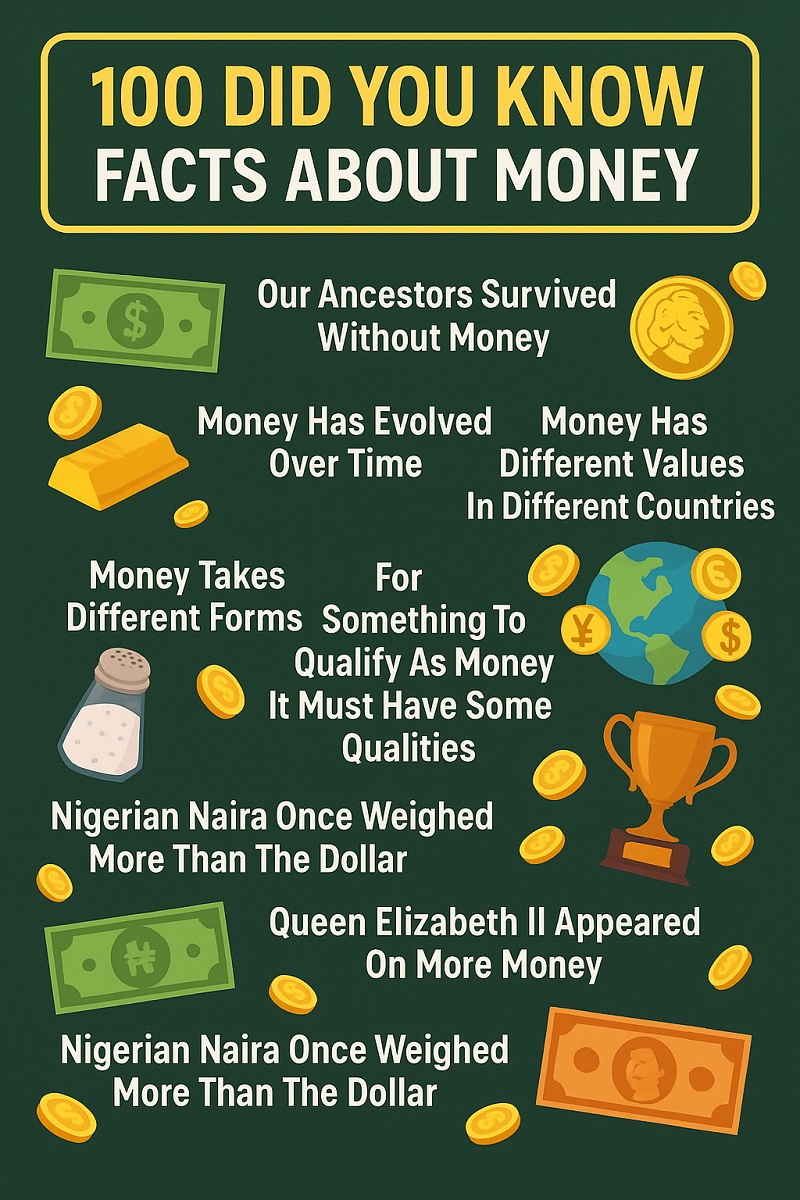
This comprehensive collection of 100 “Did You Know?” facts about money aims to provide readers—especially young people—with timeless knowledge that can improve their financial choices and overall quality of life.
100 Interesting Facts About Money (Complete Guide)
1. Our Ancestors Survived Without Money
Before modern societies, people exchanged goods through trade by barter. A farmer exchanged extra yams for fish, clothes, or tools—without using coins or cash.
2. Money Has Evolved Over Thousands of Years
Cowries served as money across Africa. Other cultures used salt, animal skins, shells, stones, gold, and eventually paper and coins.
3. China Invented Paper Money
Paper currency originated in 7th-century China, issued by banks as proof that the holder had gold or copper stored in their vault.
4. Money Used To Be Backed By Gold
For decades, major currencies were backed by gold reserves. In 1971, U.S. President Nixon ended the gold standard, changing global finance forever.
5. Currencies Differ in Strength
Exchange rates vary from country to country because of economic stability. Stronger economies have stronger currencies; weaker ones must rebuild their systems to gain value.
6. Money Comes in Many Forms
Beyond paper notes and coins, money includes gold, digital money, crypto, bonds, and even salt (still used by some Ethiopian tribes).
What Makes Something “Money”?
7. Money Must Be Divisible
It must break into smaller units—like ₦100 divided into ₦50, ₦20, or ₦10—to simplify trade.
8. Money Should Be Portable
People must be able to carry it easily, whether traveling for trade or fleeing danger.
9. Money Must Be Durable
One reason cowries and gold were used is because they last long. Barter goods like food spoil easily, losing value.
10. Money Must Be Scarce
If money is too abundant, it becomes worthless. Scarcity gives it value.
11. Money Must Be Authentic
It should be impossible to copy or forge easily. Counterfeit money destroys trust in a currency.
Historic Facts About Money
12. Nigeria’s Naira Was Once Stronger Than the U.S. Dollar
In 1980, the Naira had more buying power than the U.S. Dollar—a far contrast from today.
13. Queen Elizabeth II Appears on More Banknotes Than Anyone in History
Her face has graced the currencies of over 20 countries.
14. Early Romans Used Salt as Money
Workers were sometimes paid in salt—this gave us the words salary and the phrase worth his salt.
15. Every Bank Used To Print Its Own Money
Before standardization, banks issued their own currencies, each representing deposited gold or copper.
16. People Study Money Professionally
This fascinating field is called numismatics—the study of money, coins, and currencies.
17. Money Ink Is a Secret Formula
The ink used for printing money is not commercially available and has unique textures and security features.
18. Cryptocurrency Is a New Form of Money
Bitcoin and other cryptocurrencies have emerged as digital currencies. Though still developing, they are used globally for transactions.
19. It Costs Money to Print Money
Governments spend billions printing and replacing old notes, which is why damaged notes remain in circulation for so long.
Understanding Inflation & Economic Systems
20. Inflation Reduces the Value of Money
When inflation rises, prices increase, and your money buys less.
21. Some Economists Believe Inflation Is Inevitable
Voltaire once said: “Paper money eventually returns to its intrinsic value—zero.”
22. Fake Money Has Been Used As a Weapon
During wars, countries have counterfeited enemy currencies to destabilize their economies.
Interesting Money Facts from Around the World
23. The Piggy Bank Has Medieval Origins
It is believed that pig-shaped clay containers evolved from medieval European saving jars.
24. Banks Are Not Always Safe
Bank failures happen frequently during financial crises. Many governments protect depositors, but not always fully.
Important Money Lessons Young People Should Know
25. Budgeting Is the First Step to Financial Stability
Without budgeting, spending becomes impulsive. Planning ensures responsible use of income.
26. Financial Literacy Is Essential
Most adults lack financial education, making mistakes that could have been avoided with basic money knowledge.
27. Debt Can Be a Tool for Growth
Loans help businesses buy equipment, expand, or invest—when used responsibly.
28. Debt Can Also Destroy You
Borrowing for consumption or failing to repay leads to penalties, loss of assets, and ruined credit scores.
29. Savings Reduce Dependence on Loans
Consistent saving creates a safety net and reduces borrowing.
30. Having Money Provides Peace of Mind
Savings reduce stress and prepare people for emergencies.
31. Saving Early Creates Wealth
When combined with consistency and compound interest, early savings grow exponentially.
Investment Facts
32. Always Spread Your Investment Risk
Never put all your money into one investment. Diversifying improves your chances of earning profit overall.
33. Professionals Exist for Every Type of Investment
Stockbrokers, financial analysts, real estate agents, and portfolio managers specialize in guiding investors.
34. Insurance Protects You From Unexpected Losses
Insurance can save a person or business from financial ruin after sudden disasters.
35. Earning More Money Does Not Automatically Make You Rich
People simply increase their spending as income rises. True wealth comes from managing money—not earning more.
36. Protect Your Credit Score
Loan apps and financial institutions track repayment behavior. A poor record can prevent future borrowing when you desperately need it.
37. Financial Education Never Ends
Money systems evolve. To stay financially secure, one must keep learning.
38. Long-Term Investments Are Safer
Research shows long-term investments outperform short-term speculations.
Global Money Curiosities
39. There Are About 170 Currencies in the World
Yet most wealth is not stored in cash—it’s stored in assets like real estate, stocks, and gold.
40. There Is More Monopoly Money Than Real Money
More monopoly notes have been printed than actual physical cash.
41. Monopoly Teaches Real Money Lessons
It teaches asset acquisition, cash flow, and financial strategy.
42. Money Is Dirtier Than a Toilet Seat
Paper notes circulate everywhere, carrying bacteria and microbes. Always wash your hands after handling cash.
43. ATMs Exist on Every Continent
Even Antarctica has ATMs for researchers living there.
44. Only 5% of People Play the Lottery
And the odds of winning are about 1 in 300 million.
45. “Cash Cow” Comes from Literal Cows
Cattle were valuable assets in early societies, producing milk, calves, and wealth—hence the phrase.
46. The Most Expensive Ride Ever Was a 4-Minute Trip to Space
Jeff Bezos spent $5.5 billion to experience 4 minutes of zero gravity.
47. Government Debt Affects Citizens Directly
When countries borrow irresponsibly, the consequences fall on the people—through increased taxes, higher prices, and reduced job opportunities.
48. Countries Borrow Money Just Like Individuals
Nations take loans from institutions like the IMF, World Bank, and foreign governments. These loans must be repaid with interest.
49. Money Loses Value When Too Much Is Printed
Printing too much money without matching economic production causes inflation. Zimbabwe once printed trillion-dollar notes due to this mistake.
50. Digital Payments Are Growing Faster Than Cash
Many countries are moving toward cashless transactions—using cards, mobile apps, and digital wallets as safer, faster alternatives.
51. The Wealthiest People Rarely Flash Their Money
Many self-made millionaires live modest lives. Studies show that wealthy individuals often avoid unnecessary spending.
52. Poverty Is Often Linked to Poor Financial Habits
Lack of saving, poor spending control, and low financial literacy keep many people trapped in endless financial struggle.
53. Most Millionaires Built Wealth Slowly
Movies paint wealth as sudden, but most millionaires grew their money over decades through saving, investing, and discipline.
54. Compound Interest Can Make You Rich
Money grows exponentially when interest is added to your principal repeatedly. Albert Einstein called compound interest the “8th wonder of the world.”
55. Emergency Funds Can Prevent Poverty
Having at least 3–6 months of expenses saved can protect people from sudden financial crises.
56. You Are Your First Investment
Skills, education, and self-development often produce the highest returns over a lifetime.
57. Many People Spend Money Emotionally, Not Logically
This leads to impulsive buying—one of the major causes of hidden poverty.
58. Advertising Shapes How You Spend Money
Brands spend billions to influence your choices, even when you don’t notice it.
59. Money Mistakes Are Expensive
Wrong investments, loan defaults, and poor planning can take years to correct.
60. Your Friends Influence Your Money Habits
If you associate with spenders, you will likely overspend. If you associate with savers and investors, you develop good habits.
61. Most People Do Not Track Their Expenses
Research shows that people lose 10–30% of their income through “money leaks”—small unplanned expenses.
62. Financial Success Requires Discipline, Not Luck
Consistent habits, not good fortune, separate the wealthy from the financially unstable.
63. People Often Confuse Being Rich with Looking Rich
Real wealth is quiet—savings, investments, assets. Fake wealth is loud—designer clothes, flashy lifestyle, and zero savings.
64. The Rich Buy Assets, Not Liabilities
Assets put money in your pocket; liabilities take money out. Wealthy people focus on acquiring assets.
65. Bank Interest Is Not a Wealth-Building Strategy
Interest on savings accounts is usually too low to grow real wealth due to inflation.
66. Your Income Is Not Your Wealth
What matters is not how much you earn—but how much you keep, invest, and multiply.
67. Wealth Building Requires Patience
Most wealth comes from long-term investments, not overnight schemes.
68. “Get-Rich-Quick” Schemes Are Traps
The faster someone promises you money, the more likely it’s a scam.
69. Understanding Taxes Helps You Keep More Money
Tax planning is a key part of financial success, yet rarely taught in schools.
70. Insurance Protects Your Wealth
Without insurance, one accident, fire, or medical emergency can wipe out years of savings.
71. Money Can Buy Freedom—If Managed Well
A financially stable person has more control over their time, choices, and opportunities.
72. The Poor Spend First and Save Later
The wealthy save first, invest second, and spend what remains.
73. Side Hustles Increase Financial Security
Multiple income streams protect you when one source becomes unreliable.
74. Many People Fear Investing Because of Ignorance
Education removes fear and helps people identify good opportunities.
75. Wealth Requires Saying “No” Often
Saying no to unnecessary purchases is a key part of staying financially healthy.
76. Money Flows to Those Who Provide Value
The marketplace rewards people who solve problems or create products others need.
77. Networking Can Increase Income Opportunities
Many high-paying opportunities are shared through connections, not job ads.
78. Time Is More Valuable Than Money
You can always earn more money, but you can never get back lost time.
79. Retirement Planning Should Start Early
Young people who invest early retire comfortably—even with small monthly contributions.
80. Many Adults Regret Their Money Choices
People often admit that poor financial decisions in their 20s and 30s caused long-term struggles.
81. Children Learn Money Habits from Parents
Good or bad, your money behavior influences the next generation.
82. Money Does Not Change People—It Reveals Them
Wealth amplifies your true character, whether good or bad.
83. Rich People Think Long-Term
They think in decades, not days. This mindset shapes their spending and investment choices.
84. You Can Make Money Even While Sleeping
This is called passive income—profits that come from investments, royalties, or automated businesses.
85. Most People Are One Paycheck Away from Broke
Without savings, even a small financial setback becomes a major crisis.
86. Understanding Money Gives You Confidence
Financial knowledge helps people make decisions without fear or confusion.
87. There Is a Difference Between Wealth and Income
High earners can still be broke if they mismanage money.
88. Poverty Is Often Generational
One financially educated person can break this cycle for their entire family.
89. Money Decisions Compound Over Time
Small good habits produce big results; small bad habits cause big damage later.
90. Scammers Target Financially Uninformed People
The less you know, the easier you are to deceive.
91. The Internet Has Created New Millionaires
Digital skills, online businesses, and tech innovation have created wealth for young people worldwide.
92. Credit Cards Can Be Dangerous Without Discipline
Used irresponsibly, they create lifelong debt. Used wisely, they build strong credit.
93. Rich People Track Every Naira and Dollar
They know where their money goes—down to the smallest detail.
94. You Need a Money Plan to Build Wealth
Without a plan, income disappears into random expenses.
95. Wealth Reflects Habit, Not Luck
Luck may bring temporary riches; habits sustain long-term wealth.
96. Financial Stability Improves Mental Health
Money stress causes anxiety, depression, and poor life choices.
97. You Don’t Need Millions to Start Investing
Even small amounts invested consistently over time grow significantly.
98. Wealthy People Learn Before They Earn
Education comes first—then income follows.
99. The Biggest Money Secret Is Self-Control
Your ability to delay gratification determines how far you go financially.
100. The More You Learn About Money, The More It Works For You
Money favors those who understand it. Financial literacy is the foundation of long-term success.
Conclusion
This collection of 100 Did You Know facts about money highlights how deeply money affects our personal lives, national progress, and global systems. Many young people struggle financially not because they are unintelligent, but because they were never exposed to financial knowledge early enough.
When individuals understand money—how to earn it, manage it, protect it, and grow it—they are better positioned to build wealth. And when many citizens are financially empowered, the entire nation becomes more prosperous.
Related Posts:
- 46 Mind-Blowing Facts About Money That Would Change…
- Understanding Betting and Gambling in a Simple Way
- 6 Ways to Survive and Thrive in Tough Times
- How To Send Money From India To Nigeria Via Western…
- How to Talk About Addiction With Your Students
- The Easiest way to Create a Cryptocurrency
- Untouchable Comedy: Biography, Age, State and Net…
