
Imagine this: you have just buried your head in the tuition fee of the previous year, lived on instant noodles and even if you have been lucky to get a used textbook at a price less than equivalent to a kidney. Then, bang–here comes the next semester, then your university flippantly tells you that you have to pay more fees once again. Why? And has the Wi-Fi taken it into its head that it is time to get a pay increase? Is the dean spending money on a flock of massage chairs?
The reality is uglier but much more convoluted. The cost of university changes with every passing year due to a combination of factors that are predictable and others unpredictable like the weather. Let’s break it down.
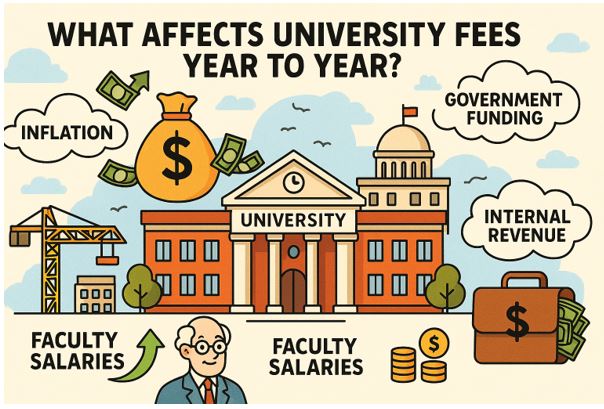
Inflation: The Silent Price Tag Sneaker
Ah, inflation. That invisible monster sneaking into every grocery bill and coffee cup—and yes, into tuition, too. Universities aren’t immune to rising costs. When the price of electricity, office supplies, and, let’s be real, avocado toast at the campus café go up, so do the expenses. Guess who gets to foot the bill? Right—students.
If inflation is around 5%, chances are, tuition will creep up at least that much just to keep the institution’s books balanced. It’s like when Netflix raises its subscription price “to improve your experience,” but you know it’s really to cover skyrocketing production budgets.
Government Funding: The Great Shrinking Wallet
In many countries, government funding is the lifeline that keeps public universities affordable. But governments have their own budget crises—wars, healthcare, roads full of potholes—and higher education isn’t always their favorite child.
When the funding shrinks, universities have to plug the gap. That usually means charging students more. It’s the academic equivalent of when your roommate cancels their share of the Netflix subscription and suddenly you’re stuck paying the whole thing.
Infrastructure and Expansion: The Fancy New Library Problem
Remember when your university unveiled that sleek, glass-covered library with chairs that looked like they belonged in a spaceship? Or the state-of-the-art gym with treadmills that could double as small spaceships? Guess what—you’re helping to pay for it.
Infrastructure projects are like weddings: beautiful, but terrifyingly expensive. Universities love to show off shiny new buildings, but those come with debt, maintenance, and bragging rights that aren’t free. Annual tuition increases often reflect these hidden costs.
Internal Revenue Streams (or Lack Thereof)
Not every university has billionaire alumni casually writing checks with more zeros than you can count. When internal revenue—like endowments, research grants, or profitable partnerships—falls short, tuition becomes the Plan B.
Think of it like running a lemonade stand: if customers suddenly stop buying, you either hike up prices or shut down. Universities, thankfully, don’t shut down (at least not overnight), but they’ll adjust tuition to balance the books.
Faculty Salaries: Brains Aren’t Cheap
Professors, researchers, and staff don’t work for free (shocking, I know). And as the cost of living rises, universities need to increase salaries to keep top talent. You want the professor with 20 years of groundbreaking research, not the one who’s just winging it off Wikipedia. But better talent means better paychecks, which, again, trickle down to students.
The Global Student Market
Universities don’t just educate—they compete. International students often pay higher tuition, and when their numbers fluctuate (say, during a global pandemic or a visa crackdown), universities scramble to stabilize revenue. That often leads to fee adjustments for domestic students, too.
It’s a bit like when your favorite local café suddenly loses tourists in the off-season—they’ll probably raise latte prices to make up for it.
Here’s a fun parallel: just like students juggling tuition increases, bettors on platforms like 22Bet juggle odds and strategies. The unpredictability is part of the game. And yes, slipping into a 22Bet login after class might actually feel less stressful than opening the university’s finance portal.
The Inflation of Expectations
Students and parents also expect more bang for their buck. Better career services, upgraded tech in lecture halls, campus mental health programs—the list keeps growing. Universities, keen to deliver, raise tuition to meet these expectations. It’s a cycle: the more students demand, the more institutions spend, the higher the fees.
The Domino Effect of Rankings
Universities obsess over global rankings. To climb the charts, they invest heavily in research, marketing, faculty hires, and even “campus experiences” designed to woo applicants. But rankings don’t pay for themselves. Tuition, once again, fills the gap.
It’s basically a beauty pageant, except instead of tiaras, the prize is bragging rights in international education brochures.
Scholarships: The Balancing Act
Ironically, the more scholarships and financial aid universities offer, the higher tuition may rise for everyone else. It’s like when airlines charge you $50 for luggage so they can advertise “free snacks” on board. Someone has to cover the cost, and it usually isn’t the university president.
So, What’s the Bottom Line?
University fees rise year to year because higher education is caught in a storm of economics, politics, and ambition. Inflation hikes up basic costs. Governments pull back funding. Universities expand campuses like they’re collecting Monopoly properties. Faculty need raises, students want services, and rankings demand investment.
For students, it’s frustrating. You budget carefully, only to find tuition has jumped again. But understanding the forces at play—economic, political, and social—at least helps you see where the money goes.
And maybe, just maybe, the next time fees rise, you’ll sigh a little less at the bill. Or at least redirect your frustration toward the university’s gleaming new fountain.
University fees aren’t random; they’re the product of a constant balancing act. Like life itself, it’s messy, unpredictable, and occasionally padded with unnecessary extras. The real trick isn’t just paying—it’s demanding accountability. After all, if you’re buying into the system, you deserve more than fancy libraries and broken vending machines.
